Research
Independent research in applied economics
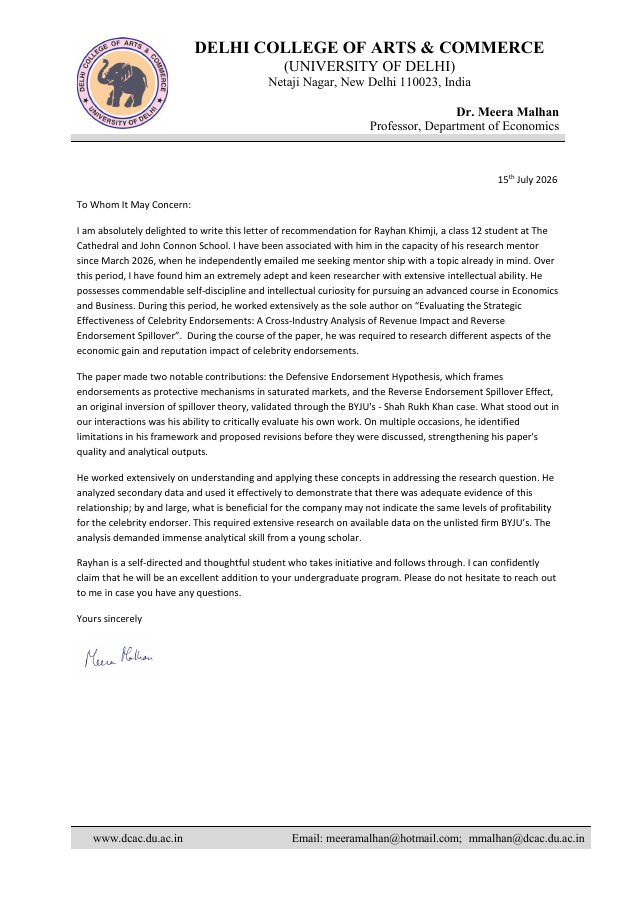
Evaluating the Strategic Effectiveness of Celebrity Endorsements
This paper asks how much celebrity endorsements actually move revenue. It combines a before-and-after comparison of company financials around each endorsement with case-study analysis across sports, beverage, sin-goods and influencer-driven brands.

Findings
Clear positive revenue impact following celebrity endorsement.
Endorsement worked defensively, protecting revenue in a mature category rather than driving new growth.
Revenue grew, but margins compressed, reflecting volatility in the sin-goods industry.
The firm’s financial decline damaged the celebrity’s reputation, the reverse of the usual direction.
Determinants of Dietary Food Prices in India
A quantitative, time-series comparison of dietary food prices in India before and after COVID. The paper asks whether prices of meat and fish, milk and milk products, and eggs are driven by inflation or by consumer interest, using the Google Search Volume Index as a proxy for interest.
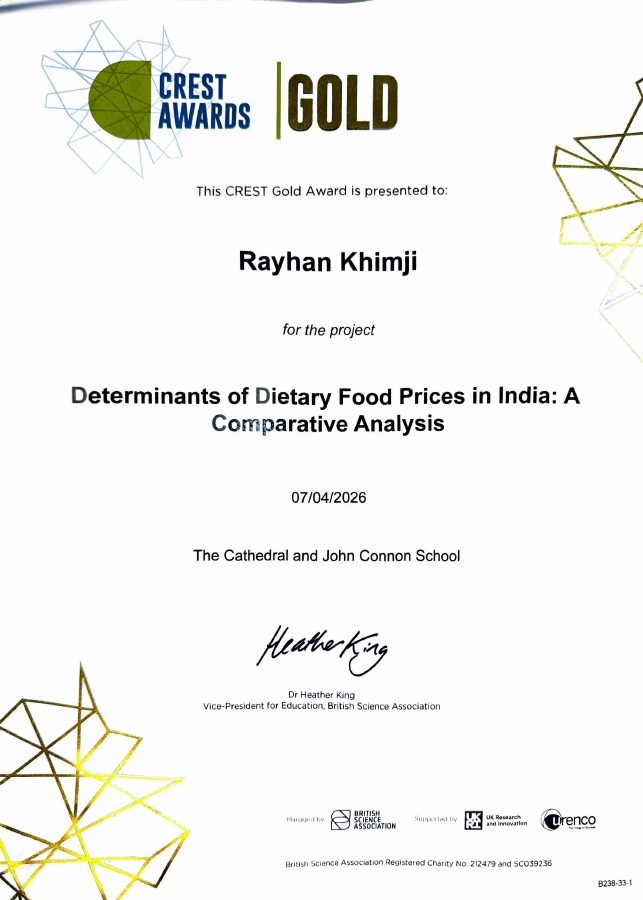 CREST Gold Award · British Science Association · View certificate
How the analysis works
Monthly prices for meat and fish, milk and milk products, and eggs, with CPI, from the RBI Database on the Indian Economy. Consumer interest from Google Trends searches for “diet” in India.
Pre-COVID, January 2019 to December 2021, and post-COVID, January 2022 to December 2024.
A separate OLS regression for each food category in each period, six in total, run in Excel. Significance at the 5% level.
H₁: pre-COVID prices track inflation, not search interest. H₂: post-COVID the inflation link weakens and consumer interest matters more.
Pricet = β0 + β1·CPIt + β2·GSVIt + εtPre-COVID · 2019 to 2021
| CPI β | Search β | |
|---|---|---|
| Meat & fish | 0.329p = 0.010 | 0.211p = 0.005 |
| Milk & milk products | 0.375p = < 0.001 | −0.054p = 0.141 |
| Eggs | 0.483p = 0.031 | 0.217p = 0.092 |
Post-COVID · 2022 to 2024
| CPI β | Search β | |
|---|---|---|
| Meat & fish | 0.438p = 0.070 | 0.119p = 0.141 |
| Milk & milk products | −0.493p = 0.006 | 0.116p = 0.048 |
| Eggs | −0.484p = 0.121 | −0.407p = 0.0003 |
Published in


Also: PARI
An anonymous nutrition-risk screening platform for students in Grades 1 to 12, with 1,007 students screened so far.